Three bumblebees in a swarm of cyclists

We know.
We’ve written about cycling before.
And yes, here we go again.
But please bear with us: At least 50% of our family aren’t just cycling enthusiasts; they’re also convinced that this two-wheeled contraption could handle a surprisingly large proportion of human mobility. Healthier. More environmentally friendly. And often even faster than the car with heated seats.
And we’ve now gathered something resembling evidence. Here. To be honest: we’re also here, in part, to validate this theory.
The Journey to School as a Motorway
Since the weather has improved, we’ve been cycling to school every day.
Five kilometres each way.
That sounds manageable at first.
But sometimes it feels like a cross between a city motorway and a beehive.
The first few days were marked by slightly elevated adrenaline levels. Overtaking manoeuvres every few seconds, cargo bikes travelling at astonishing speeds, road bikes that look as though they’ve just finished an Alpine stage. And in between them, us.
By now, it’s all going surprisingly smoothly.
Even Child 2 – who hadn’t previously stood out as a traffic strategist – now weaves confidently through the crowds. You can tell: infrastructure clearly has an effect on self-confidence too.
At the corner of Lille Langebro, we join the left-turn lane every morning. A swarm of cargo bikes, road bikes and sturdy city bikes then washes over us from the bridge.
We feel a bit like a bumblebee in a swarm of bees.
As we know, bumblebees don’t fly particularly elegantly either – but somehow they manage to keep up.
Incidentally, Lille Langebro leads quite directly towards Rådhuspladsen, running parallel to Langebro, which is more reserved for traditional car culture.
So the different modes of transport are neatly separated here – which apparently means that everyone stays fairly relaxed.
Structured chaos
At first glance, the traffic seems chaotic, but it actually works surprisingly well.
Everyone drives briskly.
Everyone knows roughly where they’re supposed to be.
Of course, there’s always the odd Mette or Ole who dawdles along on the right with us. And there are Carls, Idas, Peters and Linneas who overtake us with great determination – occasionally even running red lights.
What is surprisingly rare: shouting.
Or that accusatory ‘Didn’t you see me?’ drama that one is familiar with from other traffic cultures.
You drive. You overtake. You carry on.
The little details
At the corner of Lille Langebro, they even hand out free samples from time to time. Smoothies, for example. You’re on your way to work – and get a dose of vitamins along the way. We were happy to take them.
At larger junctions, there are small handrails that cyclists can hold onto whilst waiting, without having to dismount.
There are dedicated traffic light phases for bicycles.
And a surprising amount of waiting time at cycle junctions. It’s not all perfect, after all. Or perhaps our expectations have risen very quickly.
Turning right sometimes feels slightly absurd, because you’re standing at a red light and think: Actually, I could have been long gone by now.
Some others clearly think so too.
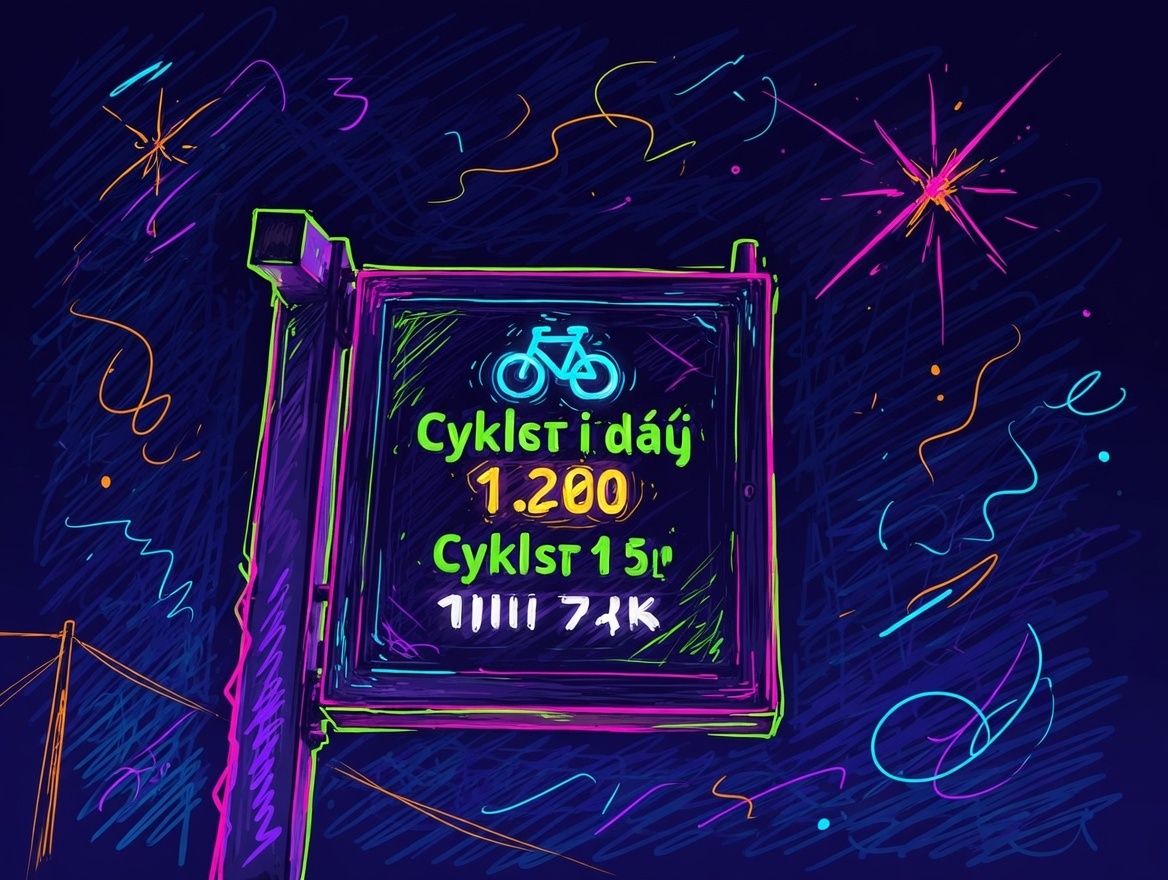
Meanwhile, the digital cycle counters display impressive figures. Even outside the city centre. Figures that make it clear: this is no niche form of transport.
Coastal weather
This afternoon: coastal weather.
That fine drizzle that seems harmless at first, but then slowly yet surely works its way through every fibre of your clothes.
There was still sunshine this morning.
Then, in the afternoon, the harsh reality of life up north.
We cycle back from school anyway.
In Berlin, the cycle paths would be pretty empty in this weather. Apart from the truly determined – that is, the ADFC or Critical Mass activists. Who then heroically trundle along the German cycle paths in functional jackets designed for Himalayan expeditions.
Here in Copenhagen?
The cycle paths are almost as busy as usual.
People are cycling in perfectly normal clothes. White trousers. Good leather shoes. Sometimes even with a smile.
We don’t yet know exactly how that works physically.
But clearly, it works.
The parking situation
Parking, too, seems… pragmatic.
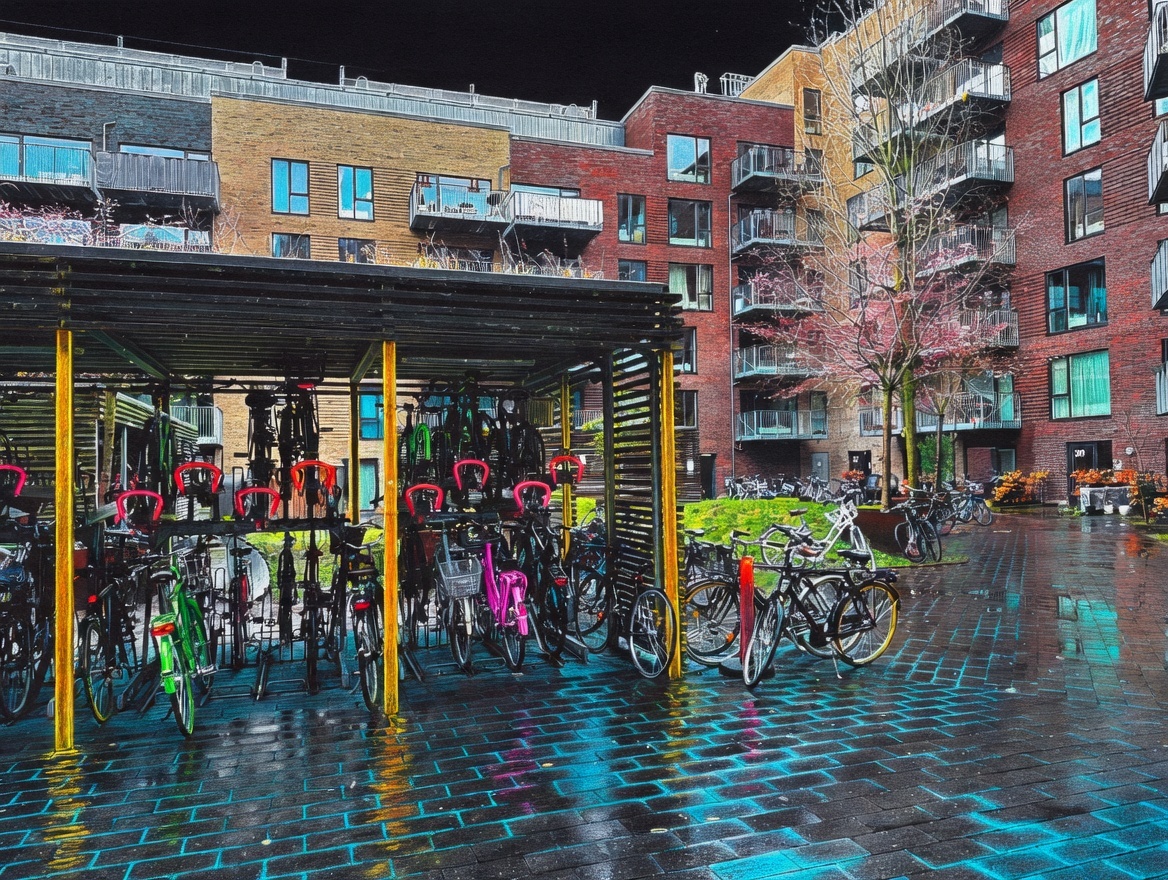
Bicycles are parked at racks, against building walls, and in courtyards. Every building looks a bit like the pavement outside a bike shop in Berlin.
There are more bikes in our courtyard than there are flats.
There are shelters. Bike parking garages. And even underground car parks, which we initially thought were for cars – until we realised that bikes are parked there too.
The rules are clearly well-defined.
Consideration – just the other way round
And then something else strikes you.
We know the feeling of constantly having to be considerate of cars when cycling. Being careful. Making way. Falling into line.
Here, it seems to work the other way round most of the time.
People in cars wait.
People in cars fall into line.
People in cars brake.
Not dramatically. Not ideologically. Simply as part of a system in which bicycles are perfectly normal road users.
Perhaps that is the real difference.
Not just that there are more bicycles on the road here.
But that nobody seems surprised when they are.
Proof. And proof that more muscle-powered mobility is possible without compromising on convenience or the economy.