Who’s actually ‘the fittest’ here?

“Survival of the fittest” always sounds a bit like a nature documentary.
Like gazelles fleeing from lions. Or like some Silicon Valley podcast where men in astonishingly expensive technical vests explain why you simply have to take a cold shower at 4.30 in the morning to win the global competition.
But when you look at societies, the question does indeed arise.
Who is actually “fit”?
The society with the most overtime?
With the highest speed?
With the toughest schools?
With the most aggressive rhetoric about performance?
Or perhaps the one where people seem reasonably relaxed and are still economically successful?
The perplexing Danish model
Let’s take Denmark, for a moment. We’re here anyway. And let’s take a closer look.
People here certainly work a lot – but not in that German mode of ‘exhausted heroism’. You know, that state where people are already telling each other in the morning how insanely full their diaries are, before anything has even happened. We know someone like that.
Overtime doesn’t seem like a moral virtue here.
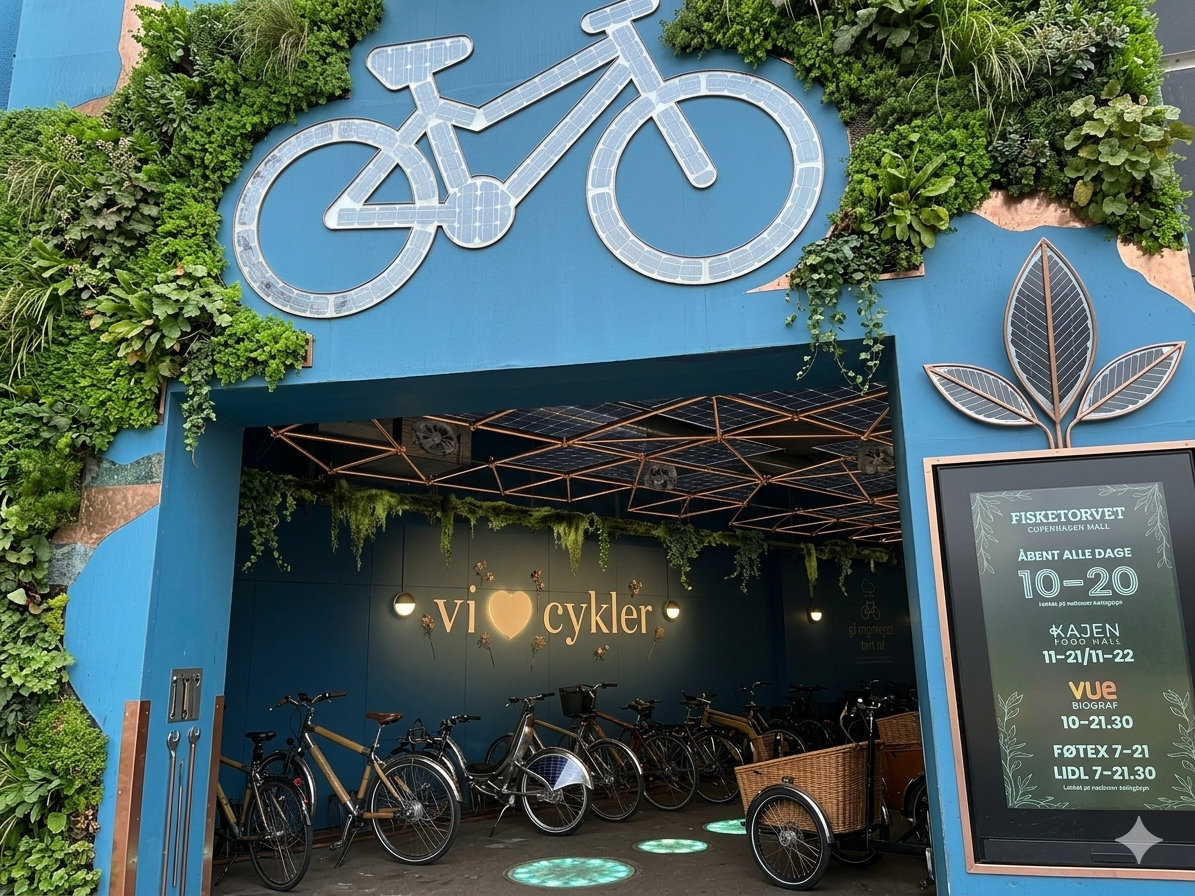
At the same time, you constantly see people jogging, cycling, swimming, doing club activities, sitting outside, picking up their children, meeting friends or simply going about their lives without visibly burning out.
And economically?
This spells trouble for German certainties.
For years, Denmark’s economy has been growing more steadily than Germany’s. The OECD currently describes the Danish economy as robust, with high employment, low inequality and sound public finances.
Germany, on the other hand, is now rejoicing over growth rates that would previously have been considered a misprint. Even slight increases of 0.2 per cent have recently been discussed almost as a national resurrection.
At the same time: high taxes, big government, little decline
Now, the standard German narrative would actually be quite different.
High taxes?
Significant redistribution?
A strong welfare state?
Short working hours?
Bicycles instead of cars?
A better quality of life rather than maximum efficiency?
Surely that would lead straight into an economic abyss.
But surprisingly, it doesn’t. At least so far, there are no signs of it.
According to the OECD, Denmark regularly ranks among the top countries for life satisfaction. On average, people there rate their lives significantly more positively than the OECD average. We have too, by the way, for the past three months.
And economically, too, the country is by no means standing on the brink of collapse like some romantic eco-state.
On the contrary.
But be careful: the picture is more complicated
However, it would be just as wrong to immediately cobble together the next Scandinavian ‘doctrine of salvation’ from this. Viking heroes, or something like that.
Because, of course, there are massive differences between Germany and Denmark.
Denmark has just under six million inhabitants. Germany has over eighty million.
Germany is an industrial nation with extremely energy-intensive sectors, high dependence on exports and a complex federal structure. Denmark is smaller, more flexible and has a different economic setup. Established structures, certainly. Do they have to be that way? For now, yes, but perhaps not in the long run.
Furthermore, Denmark benefits greatly from a number of internationally highly successful companies – particularly in the pharmaceutical sector. We know someone there. The OECD explicitly points out that a significant proportion of the strong growth is driven by a small number of large, globally active companies.
So one could say:
Perhaps we are sometimes comparing a very large tanker with a fast Scandinavian speedboat.
Explanatory Approach 1: Trust as an Economic Factor
One possible difference could be trust.
Not just personal trust, but a fundamental level of social trust.
That rules are generally followed. We discussed this right at the start of this blog.
That the state basically functions.
That other people aren’t constantly trying to cheat you.
That sounds soft. Almost esoteric.
But it is actually quite relevant economically.
Because societies with a high level of trust often need less control, less bureaucracy, fewer safeguards. This makes things clearer.
Transactions become simpler. Collaboration becomes cheaper. Changes are accepted more readily.
And perhaps that also explains why people here are more willing to try things out pragmatically, rather than overthinking them in committees for three years beforehand. Not every idea that doesn’t work is a ploy. Sometimes you just have to give it a go.
Explanatory Approach 2: Less Perfectionism, More Adaptability
The second point is almost uncomfortable.
Perhaps Germany is sometimes too perfectionist.
Or to be more precise: too perfectionist when it comes to preserving and improving existing systems. We’ve touched on this before – here on the blog. Take our flat, for example.
In Denmark, many things seem less optimised to the max – but at the same time easier to change.
People are more likely to accept 80 per cent solutions if they work in practice.
In Germany, on the other hand, action is often only taken once a solution appears absolutely perfect, legally sound, compliant with standards and completely risk-free from an emotional perspective.
This does lead to excellent socket standards.
But it may not always lead to rapid adaptability. Just think of the removal of a car park to make way for cycle lanes.
Explanatory Approach 3: Quality of life is not a luxury issue
And perhaps there is a third point.
Denmark clearly treats quality of life as less of a side issue.
Sport. Community. Public spaces. Cycling. Flexible working. Family time.
Here, this is not immediately seen as a soft, anti-business policy.
Rather, it is seen as the foundation for ensuring that people remain productive in the long term.
The OECD regularly points out that well-being, health, social participation and economic productivity are closely interlinked.
So perhaps the question is not:
“How do we maximise performance in the short term?”
But rather:
“How do we organise society so that people can function sustainably without wearing each other down?”
And Germany?
Of course, it would be simplistic to simply turn this into a “Germany bad, Denmark good” narrative. That would be a bit silly for us, as we do enjoy living with our friends and families in Germany.
As a visitor, you don’t notice some of Denmark’s problems at first. Even for us, after three months, some things only become clear during longer conversations or as we gain more insight.
For example, the high cost of living. We reported on this.
Housing problems.
Reliance on a few growth sectors.
Demographic challenges.
Or the question of whether small, homogeneous societies can simply organise certain models more easily. As Richard David Precht would say: “The happiness of small countries”.
Furthermore, it remains to be seen how robust the Danish model is in the long term against global crises, geopolitical tensions or economic upheavals. For the moment, at any rate: good. Better. Without a pension from the age of 90.
Perhaps the real question is a different one
Perhaps it is not at all about which country is ‘fitter’.
But rather about what we actually mean by ‘fitness’.
Maximum short-term efficiency?
Or long-term social stability?
Individual performance enhancement?
Or collective resilience?
And perhaps Germany should ask itself less:
“How do we get people to work even harder?”
Rather:
- Why do so many people seem exhausted despite their prosperity? Some of us included.
- Why does change often immediately trigger fear? See: a cycle path instead of a car park.
- Why is community so quickly seen as a sign of inefficiency?
- And why do we find it so hard to believe that quality of life itself could be an economic location factor?
Open Ending
We don’t have a definitive answer. Still don’t. Have we failed?
Let’s be kind to ourselves: neither a stay in Copenhagen nor half a stack of OECD reports is enough for that.
But perhaps it’s worth taking a closer look.
Not just at growth figures.
But at the interplay of trust, infrastructure, education, health, work culture and how we interact with one another as a society.
Because perhaps the question of who is ‘fit’ isn’t decided by who runs the fastest. Even if we love running.
But by who doesn’t get completely out of breath in the long run.
Can we find out more? We still have three months left.