Cycle more, you fools!
There are certain phrases where you know right away: This isn’t going to work. “Start biking more already!” definitely falls into this category. Right alongside “Just pull yourself together!” and “Please, everyone, be more innovative.”
A government that wants to use moralistic lecturing to encourage its citizens to ride bikes will likely assume in other areas as well that people are fundamentally prone to having silly ideas. Consequently, it might also require doctor’s notes starting on the very first day of sick leave, sell longer working hours as a motivator, or assume that commitment arises primarily when it’s mandated. True to the motto: Trust is good, control is the government’s agenda.
However, it is hardly a revolutionary insight of the 21st century - neither in education nor in employee management - that lecturing rarely sparks enthusiasm. People don’t change their behavior just because they’re told to do so more often. They do so when the conditions are right - when the desired behavior is easier, more appealing, or simply more reasonable than the alternative. Those who don’t feel valued rarely develop a spontaneous desire to show even more commitment. Quite the opposite, in fact.
Tak fordi du cykler
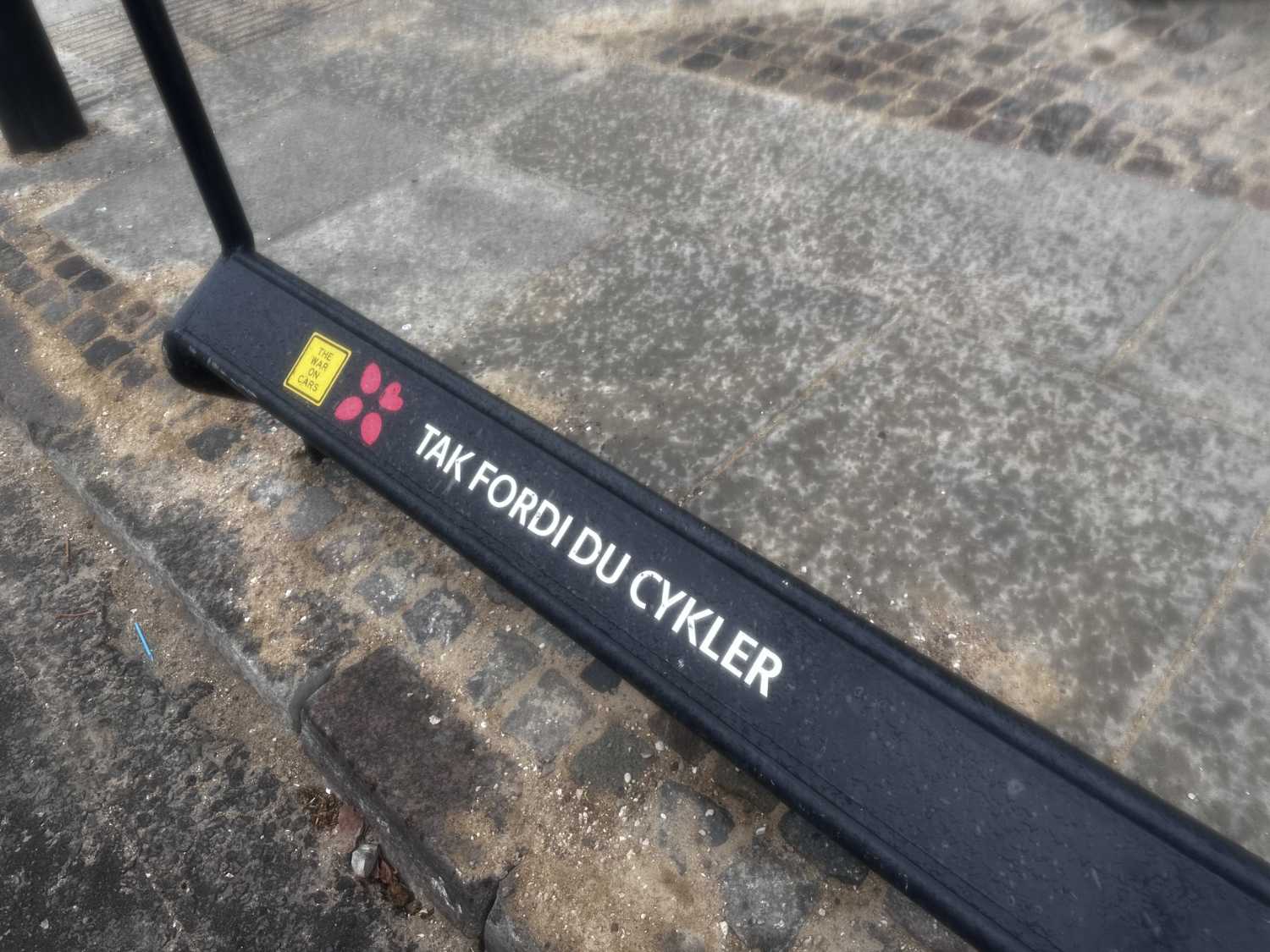
In Copenhagen, many traffic lights display the message: “Tak fordi du cykler” – “Thank you for riding your bike.”
First of all, that’s refreshingly unpretentious. No “Now get your act together!”, no “Your car is destroying the planet!”, no grumpy appeal that sounds as if the public were personally responsible for all of Europe’s traffic problems. Just a thank you.
But the real difference isn’t on the sign—it’s right below it.
The traffic light has a small footrest where cyclists can comfortably rest their feet without getting off their bikes. Next to it runs a wide, safe, and physically separated bike path. So the message isn’t just: Thank you for riding your bike. Above all, it says: We’ve made it as comfortable as possible for you.
That’s exactly where the difference lies between symbolic politics and practical design.
What's with all this cycling again?
Don’t worry. This isn’t going to be yet another love letter to Denmark’s bike path network. We’ve already written more about that than some municipalities have built bike paths. And since we’ve just cycled from Sweden to Denmark again, there’s a risk we’ll go completely off on a tangent anyway.
Something else is more interesting, anyway.
The principle behind the bike traffic light is surprisingly often reflected in the political goals of the new Danish government. Instead of dictating to people what they should do, it’s trying—at least in many areas—to change incentives and framework conditions so that the desired behavior becomes more natural.
This includes, among other things, extensive tax and fee relief for citizens. Measures that have been discussed or announced include lower taxes and fees, significant relief on food prices with a special focus on fruits and vegetables, and changes to income tax, including the elimination of the previous top tax rate. The idea behind this is not only to strengthen purchasing power but also to make healthier eating more financially attractive.
Another example is free public transport for young people. Those who get used to travelling by bus and train from an early age often continue with this pattern of travel later in life. After all, habits aren’t formed by empty rhetoric, but through everyday life.
Denmark also continues to focus on structural changes when it comes to climate protection. Large areas of farmland are to be converted into nature reserves and forests over the long term. At the same time, the ecological transformation of agriculture is being driven forward - in part through a CO₂ tax on livestock farming - and the expansion of renewable energy continues. The goal remains to reduce dependence on fossil fuels - not only from a climate perspective, but also for reasons of energy security.
Of course, the picture is not entirely free of contradictions. Denmark’s comparatively strict immigration policy remains in place and is only partially consistent with the country’s otherwise often progressive self-image. Tax breaks for high earners are also viewed differently. Some see them as a necessary contribution to competitiveness, while others view them as an unnecessary reward for those who are already well-off.
That is precisely why it is worth taking a closer look at the basic principle
In many areas, the government is trying to focus less on lecturing people and more on changing the framework conditions. People should buy fruits and vegetables because they’re cheaper—not because posters remind them to eat broccoli. Young people should take the bus and train because the service is attractive—not because they’re told they’re saving the future. And businesses and the agricultural sector should operate in a more climate-friendly way because the economic incentives are changing.
People behave reasonably surprisingly often when being reasonable isn’t the most complicated option.
Perhaps that is precisely the real lesson from Copenhagen.
It’s not the sign with the friendly “Thank you for riding your bike” that makes the difference.
It’s the bike lane underneath it.