The situation at the ‘Change Muscle’ gym
There is, of course, this comforting notion that people tend to develop as they get older: that everything about them is now complete. Not perfect, but complete. Their character has been fully formed, their habits have set like good concrete, and the only major changes conceivable are in the form of new reading glasses or orthopaedic insoles.
In any case, people would have said that we’re rather set in our ways. Not in a negative sense. More like solid. Time-tested. Endowed with a certain staid tenacity that reliably explains why we’ve always done things this way.
And now we’ve been in Copenhagen for about four months and have come to realise: apparently, we’re far more adaptable than we thought.
Not because everything is different here. That would be nonsense anyway. People go shopping, go to work, forget birthdays, lose gloves and discuss politics just like anywhere else.
But a lot of things do, in fact, work differently. And the most astonishing thing isn’t that things work differently. The most astonishing thing is how quickly the unfamiliar becomes part of everyday life.
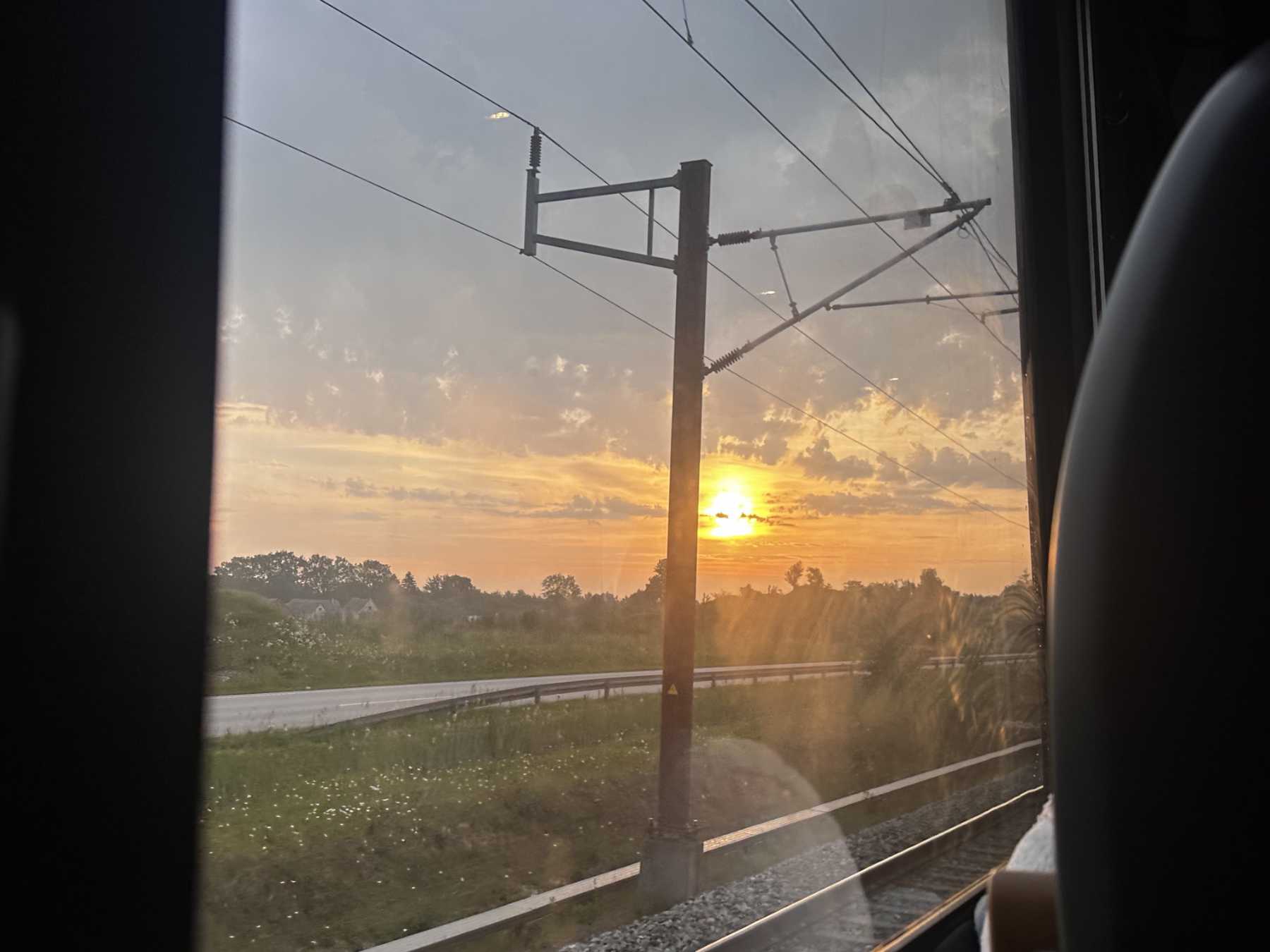
The night train is now a bit like a tram
In the past, a night train journey was quite an event.
Something that was planned. With anticipation. With research. With the feeling of embarking on a little adventure.
We’d tell our friends about it: “We’re taking the night train.”
This was usually followed by an appreciative nod, as if we’d just announced we were walking the Camino de Santiago or sailing to Iceland.
Today?
Today, we board a night train more or less casually to sort out organisational matters relating to our flat in Berlin.
Not a luxury train, mind you.
We’re saving money, of course, and book seats where you wake up in the morning feeling about as relaxed as a folded-up camping chair.
But even that feels surprisingly normal these days.
We factor in the need to catch up on sleep straight away, know the routine, have a rough idea of when the coffee will be available, and accept that our undeniably ageing backs might have a slightly different opinion on the subject of travel comfort the next day.
It’s much the same with the Flixbus.
Once a stopgap solution.
Nowadays, it’s often simply the most sensible option. Cheaper. Often surprisingly reliable. And no longer an adventure.
What used to be travel is now logistics.
The thing about other people
What’s even more astonishing is something else: our character seems to be transferable. And yet, at the same time, it isn’t.
When we’re in Copenhagen, we behave differently.
Not on purpose. Not because we get up in the morning and say, ‘Today we’re going to be better people.’
But simply because it happens.
We don’t cycle too close to others, we don’t push our way through, we let others go first, we’re really considerate, and we almost always smile at people.
And not for educational reasons or because we’ve booked a course in positive communication, but because everyone else does it too.
We’re treated politely and respond with politeness: an astonishingly simple social concept.
No sooner are we back in Berlin, however, than things start moving in the opposite direction again, astonishingly quickly. Not completely, but noticeably.
For example, someone calls out something from behind. In Copenhagen, we think: ‘Oh, it must be a helpful tip.’
In Berlin, we know: it’s either an insult or a reproach. We ask ourselves: “What have we done wrong now?”
And alarmingly often, we’re right in our assessment.
In Denmark, a shout often consists of warnings such as: “Watch out, someone’s coming!” or “It’s nicer to sit over there!”
In Berlin, the message is often more like: “You’re in the way.” And that would actually be the more polite version. Most of the time, it’s more like “Piss off, you idiot”.
What’s fascinating about this is not so much the observation itself as the speed at which it happens.
We switch gears within a matter of minutes.
It’s as if our brain had installed different social modes and automatically loads the appropriate software when we cross a boundary.
New environments
Our first explorations on foot or by bike: feeling our way, marvelling, a little unsure. The routes we walked and cycled along have stayed with us. But they also felt exotic. Now, after just a few months, we know our way around here as well as we do at home. We know the back streets, the best spots, the lovely paths, and have an almost perfect sense of distances.
It almost feels like home already. How is that possible, after just over four months?
Chocolate as a luxury good
Something strange happens when it comes to food, too. We’ve mentioned several times already that Denmark is expensive. And I mean really expensive.
Especially when it comes to anything you could, in all conscience, describe as non-essential.
Chocolate, for example – or other forms of industrially produced bliss.
And lo and behold: as soon as a bar of chocolate suddenly costs as much as a small lunch used to, we automatically start to wonder whether we really need it. Even the road cyclist.
The result is surprisingly unspectacular: we simply buy it less often. Even the road cyclist. And we all miss it surprisingly little.
Fruit and vegetables, on the other hand, we buy almost exactly as much as before. The differences there aren’t all that huge. It’s only with junk food that a kind of economically driven self-discipline suddenly kicks in.
And the astonishing thing is: it doesn’t feel like a sacrifice at all, but rather like a tacit agreement between our wallets and our common sense.
Perhaps people aren’t that complicated after all
After four months, one thing stands out above all else: people are far less attached to their habits than they like to claim.
At least as long as our surroundings change along with us.
We like to tell ourselves that’s just the way we are. And that, at our age, we won’t change any more. We tell ourselves that our character, habits and behaviour are set in stone.
And then we move to another country for a few months and realise: apparently, sometimes a different environment is all it takes to completely reorder things.
We drive differently, we eat differently, we travel differently and we interact with other people differently. The real challenge, therefore, will probably not be learning these things here.
The real challenge will be bringing this mindset back with us. Especially when it comes to friendliness.
Because: night trains can be booked. Consideration is something we need to export. That’s what we’ve set out to do.